



-
 聯絡資訊
:
分機:382
聯絡資訊
:
分機:382
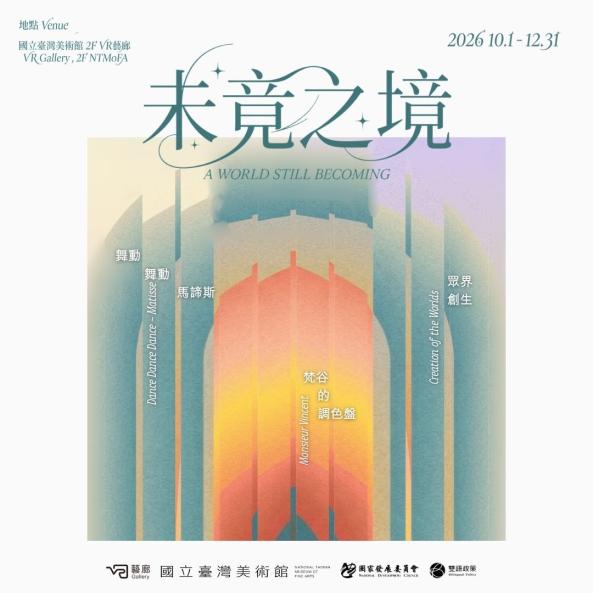
未竟之境 A World Still Becoming
一筆未收,一舞未停,一界未成。
當繪畫走出畫框,走進的不只是虛擬空間,更是藝術家的內在宇宙。梵谷重新定義了色彩如何承載情感,讓後印象派走向了表現主義的門檻;馬諦斯用一生的時間,證明線條與色塊本身就能構成完整的世界,開啟了野獸派、影響了整個二十世紀的繪畫語言;丘爾利歐尼斯則在西方藝術史還沒有「抽象」這個詞之前,就已經把音樂的結構畫進了畫布,是歐洲抽象藝術與視覺音樂數一數二的早期先行者。三人相隔的世代與國界都不算近,卻各自在藝術史的轉折點上,留下了後人繞不開的位置。這一次,我們選了三部各自停在他們創作生涯裡,還沒來得及闔上的那一頁的作品——不是把一幅畫做成它完成後的模樣,而是把它拉回還沒完成、還在呼吸的那個瞬間。
梵谷最喜歡的黃色,是向日葵的黃,是麥田的黃,是南法陽光曬了一整個夏天的顏色。《梵谷的調色盤》借嘉舍醫生之女瑪格麗特的聲音,帶觀眾推開那扇門,走進醫生家的起居室——曾經迴盪著鋼琴樂聲的地方,牆上掛著一張張老照片。一隻翠鳥穿越畫框,領著人踏上一段不朽的旅程,路過咖啡店溫暖的燈光,路過星夜的璀璨,路過藍與綠交疊出的波動,也路過那些扎根在大地深處,安靜生長的東西。經典之所以能被再現,是因為那一筆,其實從來沒有真的落下句點——調色盤上的顏料,永遠留著剛剛被調開的樣子,等著下一個人,伸手觸摸。
馬諦斯的舞,跳了一輩子,跳到其中一版,乾脆就叫做「未完成」。巴恩斯基金會找他畫《舞蹈》,第一版畫到一半,他自己不滿意,隨手擱在畫室的角落,一放就是幾十年,後來才被人翻出來,如今這幅畫的名字就叫《未完成之舞》。他重畫了第二版,尺寸卻算錯,掛不上去;直到第三版,才終於穩穩落在牆面上。從紐約現代藝術博物館,到巴黎現代美術館自己的收藏,每一次的《舞蹈》,都只是上一次沒跳完的,接著跳下去。《舞動舞動馬諦斯》把這支舞,交還給觀眾自己的身體——那一筆,同樣沒有真正落下句點,只是換了一個人,繼續舞著。
丘爾利歐尼斯望向的,從來不是眼前這個世界,是更遠、更古老的東西——星圖、神話、還有音樂裡才有的那種秩序。他相信色彩跟聲音,本來就是同一種語言,用畫布寫的曲子,也可以是一首交響詩。他畫的創世系列,也是這樣一路畫下去的,畫到宇宙成形,畫到大水退去,畫到城市在山巒間浮現,卻始終沒能畫到人類誕生的那一天——十三幅,停在第五日,缺席了本該完成整個創世的第六日。這樣的未完成,不是遺憾,是他口中「另一個、幻想出來的世界」,本來就該有的、敞開的樣子——就像他這一生留下的其他系列,也都各自獨立,各自呼應,沒有一組真正說完過整個宇宙。《眾界創生》讓觀眾走到旅程盡頭時,從一個路過的人,變成這個還沒完工的世界的守護者。
三段未竟,彼此無關,卻在同一個姿態裡,相遇了:所謂經典,從來不是一支已經收好的筆,是一支一直被允許,重新拿起來,再落下去的筆。所以,經典再現這件事,說不完,也不必說完——未竟之境,只是這條路上,暫時停下來的一站,後面,還有更多還沒被畫完的世界,等著被走進去。
A World Still Becoming
Curatorial Statement
One brushstroke never set down, one dance never stopped, one world never finished.
When a painting steps outside its frame, what it enters is never just a virtual space — it is the artist's own inner cosmos. Van Gogh redefined how colour could carry emotion, pushing Post-Impressionism to the threshold of Expressionism. Matisse spent a lifetime proving that line and colour alone could build a complete world, opening the door to Fauvism and shaping the visual language of the entire twentieth century. Čiurlionis, before the West even had a word for "abstraction," was already painting the structure of music onto canvas, and stands among Europe's earliest pioneers of abstract art and visual music. Separated by generations and borders, all three left a mark on art history that no one after them could paint around. This time, we've chosen three works that each dwell on a page their maker left unturned — not the shape a painting settled into once it was done, but the shape it held while it was still becoming.
Van Gogh's favourite yellow was the yellow of sunflowers, the yellow of wheat fields, the colour of a whole summer of southern light. Monsieur Vincent borrows the voice of Marguerite, daughter of Dr. Gachet, to lead visitors through that door, into the sitting room of the doctor's house — a room that once held the sound of piano music, its walls lined with old photographs. A kingfisher slips through the frame, leading the way on an immortal journey, past the warm lights of a café, past the brilliance of a starry night, past waves of blue folding into green, and past whatever lies quietly rooted in the earth beneath it all. A classic can be reimagined precisely because that brushstroke was never truly set down — the paint on the palette stays exactly as it was the moment it was mixed, waiting for the next hand to reach for it.
Matisse's dance went on so long that one version of it is simply called unfinished. Commissioned by the Barnes Foundation to paint The Dance, he abandoned his first attempt halfway, unhappy with the composition, and left it in a corner of his studio for decades before it resurfaced — today it carries the name La Danse inachevée, the unfinished dance. He tried again; the second version was miscalculated and could not be hung. Only the third finally settled onto the wall. From MoMA to the Musée d'Art Moderne de Paris's own collection, every Dance was simply the last one, taken up again where it had stopped. Dance Dance Dance – Matisse hands that dance back to the visitor's own body — the same brushstroke, in someone else's body now, still moving.
What Čiurlionis looked toward was never this world, but something older, farther away — star charts, myth, and the kind of order that only music seems to hold. He believed colour and sound were, at heart, the same language, and that a symphony could just as easily be written across a canvas. His creation cycle unfolds the same way — the universe taking shape, the flood receding, cities rising out of distant mountains — yet it never quite reaches the day humanity was made. Thirteen paintings, stopping at the fifth day, never arriving at the sixth that would complete the act of creation. That incompleteness isn't a shortfall — it's the open, unfinished shape his other, imagined world was always meant to hold, much like every other cycle he left behind: independent, echoing one another, none of them ever quite finishing the whole. By the end of the journey, Creation of the Worlds turns you from someone passing through into someone keeping watch over a world still being made.
Three unfinished chapters, unrelated to one another, arrive at the same posture: a classic was never a brush laid down for good. It is one that keeps being picked back up and set down again. Reimagining a classic is a story that never quite ends and doesn't need to — A World Still Becoming is only one stop along the way. There are more unfinished worlds ahead, waiting to be entered.
歡迎同步上VR藝廊預約網址預約參與體驗:https://linktr.ee/vrgallery?utm_source=linktree_profile_share


