


 2026/10/27 10:00
~
2027/03/14 18:00
2026/10/27 10:00
~
2027/03/14 18:00

-
 Organizer
:
Ministry of Culture, National Taiwan Museum of Fine Arts, National Center of Photography and Images
Organizer
:
Ministry of Culture, National Taiwan Museum of Fine Arts, National Center of Photography and Images
-
 Contact Us
:
(02) 8978-7040
Contact Us
:
(02) 8978-7040
-
 Ticket Details
:
free
Ticket Details
:
free
-
 Opening Times
:
10:00 to 18:00 Tuesdays to Sundays, Closed Every Monday and on Lunar New Year’s Eve and Lunar New Year’s Day.
Opening Times
:
10:00 to 18:00 Tuesdays to Sundays, Closed Every Monday and on Lunar New Year’s Eve and Lunar New Year’s Day.
-
 Available Services
:
Photography Allowed、Information、Wi-Fi
Available Services
:
Photography Allowed、Information、Wi-Fi
Exhibition Dates:2026.10.27—2027.3.14
( The Body as Language:2026.10.27—2027.3.10/The Body as Spectrum:2026.11.11—2027.3.14)
Venue:National Center of Photography and Images, Taipei.
(The Body as Language:galleries 301-303,305/The Body as Spectrum:galleries 201-203)
Curator:TENG Po-Jen
Artists:Isa HO, Nymph LEE×Manbo Key×LIN Chien-Wen,
LEE Ti-Chin, CHOU Fang-Yu, Qiqi CHEW, LIN Hou-Jun,
Joshua LIN, LIN Tien-Fu, AL Poshi, SHIY De-Jinn,
CHANG Liang-I, CHANG Kuang-Ho, CHUANG Ling,
Leslie HSU, KUO Pei-Chi, QUO Ying-Sheng, CHEN Yung-Hsien
Jamei CHEN, CHEN Chun-Lu, CHEN Chin-Pao, LIU Yi-Chun,
LIU Chen-Hsiang, TSAI Ting-Bang, TSAI Jung-Li,
DENG Nan-Guang, Civi Szu-Wei CHENG, LU Wei,
HSIEH Chih-Ching, Anna Yun-Ching HAN, SU Hou-Wen,
Liang SU×CHiNGLiSH WANG, JONG Yi-Ling
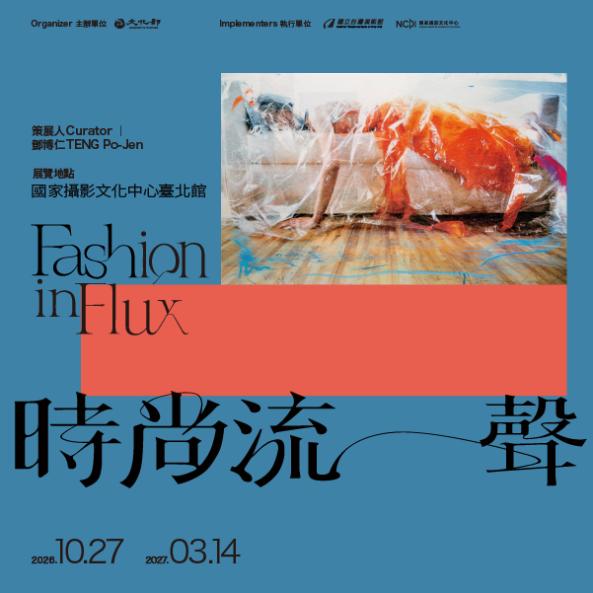
Fashion in Flux: The Language We Wear
“Each of us lives inside our own clothes.”
—Eileen Chang, “A Chronicle of Changing Clothes”
Fashion in Flux: The Language We Wear begins at the intersection of photography and fashion, exploring how the body is perceived and remembered in images and how it gradually comes to convey cultural meanings and experiences across eras.
Fashion is a form of cultural language, articulated through clothing, gestures, the body, and images. Its fluid circulation depends on viewing, imitation, and reinterpretation, which reflect both how a society understands itself and how others perceive it. Together, clothing, gestures, and images constitute recognizable visual vocabularies, enabling emotions, identity, desire, and memory to take shape over time. A single garment can inspire imitation; a particular gesture can become a style; an image can influence or reshape our perception of ourselves and others. As these representations circulate through magazines, newspapers, advertisements, branding, and digital platforms, fashion emerges as an essential medium for cultural memory, social imagination, and the zeitgeist.
The exhibition is divided into two subthemes: “The Body as Language” on the third floor and “The Body as Spectrum” on the second. The first, starting with the body and the gaze, explores how images shape viewing dynamics, allowing the body to respond to the world. The second floor expands into everyday life, socio-cultural contexts, and digital technologies, showing how style becomes fluid, translated, and represented across different fields. Positioned vertically, these floors work together as two sides of the same coin: one focuses on how the body communicates, while the other examines how different eras leave imprints on the body.
This exhibition brings together thirty-five artists, ten of whom are women, and features early portraits (shashin), family photos, commercial photography, contemporary art, and artificial intelligence (AI) works, illustrating the ongoing evolution of Taiwanese fashion imagery across eras and media. Together, these works demonstrate that fashion transcends the mere display of style; it is an accumulation of ways of viewing, as well as a space where the body, culture, and society intersect.
When clothing appears in images, the body becomes readable text; when images infiltrate daily life, style becomes a means of recognizing ourselves and understanding the world. As a result, fashion shifts from being merely a wearable decoration to a cultural language that expresses existence, memory, and identity.
Through these works, we revisit a seemingly everyday yet deeply significant question: how we dress ourselves and, in the eyes of others, how we gradually come to see ourselves.
The Body as Language
Fashion is a language closely connected to the body. When clothing appears in images and gestures draw attention, the body begins to convey emotions, memories, and cultural meanings. Photography, clothing, and the gaze become intertwined, revealing subtle yet recognizable traces of the individual’s identity within the image and gradually forming a unique personal style.
The Body as Language” begins with everyday life and performance, examining settings such as the home, the street, and the theater to trace the development of Taiwanese fashion images across portrait, commercial, and artistic contexts. By juxtaposing works from multiple generations, the exhibition shows how the body progressively learns to express itself through continual cycles of observing and being observed.
As self-awareness in viewing develops, the image begins to offer new ways to rethink the body’s role and significance. Clothing goes beyond being just an external decoration; it becomes a means for individuals to respond to their environment, while gestures reflect both explicit and subtle cultural imprints on the body. Consequently, the body is not just a vessel for style but actively articulates its own cultural expressions and modes of existence through the image.
What “The Body as Language” delineates is precisely how the body is interpreted in images and how, through the interaction between the gaze and the returning gaze, it arrives at its own way of seeing.
The Body as Spectrum
When fashion becomes part of daily life, style becomes a cultural landscape attached to the body. Our clothing is more than what we wear; it reflects the imprints of the times, society, and personal experiences that have left their mark on us.
“The Body as Spectrum” explores three dimensions—portrait, everyday life, and the virtual—to observe how clothing and images continually evolve within social frameworks, popular culture, and technological contexts. Spanning a gradient from bodily expressions in vernacular life to the re-coding of style by digital platforms and AI, this spectrum maps a contemporary landscape shaped collectively by memory, desire, and technology in the exhibition.
In this landscape, the body reflects personal emotions and perceptions, as well as how society views and classifies us. Style thus acts as a way of being, enabling us to establish our identity and place in a constantly changing world.
What “The Body as Spectrum” demonstrates is how fashion subtly manifests in life and continues to shape the image of our current era.
Organizer|Ministry of Culture
Implementers|National Taiwan Museum of Fine Arts, National Center of Photography and Images


