 2026/09/29 09:00
~
2027/08/29 18:00
2026/09/29 09:00
~
2027/08/29 18:00

-
 Organizer
:
National Taiwan Museum of Fine Arts
Organizer
:
National Taiwan Museum of Fine Arts
-
 Contact Us
:
+886-4-23723552 ext.334(Mr. Chiang), ext.338(Ms. Huang), ext.335(Ms. Liu)
Contact Us
:
+886-4-23723552 ext.334(Mr. Chiang), ext.338(Ms. Huang), ext.335(Ms. Liu)

 Foreword
For Grown-Ups, Still in Bloom
Let’s see art through children’s eyes!
In daily life, we rush to “read” words. But in art, words can break rules and become the picture itself. Slow down with your child, and watch three classics from the NTMoFA turn text into landscape and symbol. We have also invited artists from Singapore, Japan, and Korea, whose cultures carry elements of Chinese characters, to share their new works in this international dialogue. Unveil the secret in between “words” and “art” together with your child!
For Little Ones, Slowly Taking Root
Let’s explore art with adults!
Have you noticed? Words have quietly jumped into the art. Once in art, words run free! They can be a mountain, an animal, or a house. They can also be a symbol with a sound or a memory. In this exhibition, keep your eyes wide open, and hunt for secrets in the art like unwrapping a gift. Let’s see how words transform into art!
Exhibition Sections

..NTMoFA collection | Lyu Fo Ting "Painting Composed by Oracle-bone Script"..
X
..NTMoFA commission | Song Joo Yean(Korea) "Home of Letters"..
Did you spot a “house” made of words in both of these artworks?
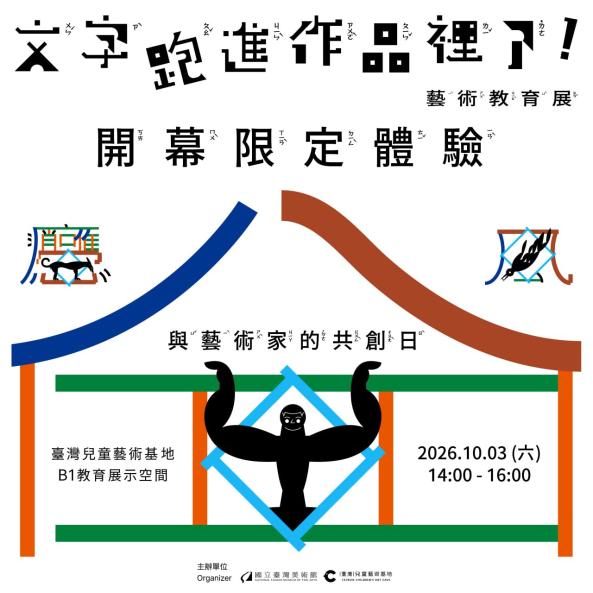
The NTMoFA’s collection includes a work by Lyu Fo Ting, who arranges ancient oracle bone script, each character finding its place, into a flat, painted landscape of words. Korean artist Song Joo Yean takes that same imagined world and brings it into real space, building a three-dimensional “Home of Letters ” installation. Off you go and see if you can find the words hidden in these two artworks!
Lyu Fo Ting was a master of oracle bone script. He didn't just put each character in its place; but even wove them together into a magical landscape painting!
Beneath a towering mountain (山), birds and swallows (鳥, 燕) soar through the sky. On the ground stand four dwellings (室) . In the foreground, you'll find a deer (鹿), a dog (狗), and four people (人), each in a different pose. It is said that beyond oracle bone script, Lyu also borrowed two ancient characters, “受” and “嘉,” transforming them into clouds drifting across the sky. Did you spot them all? What do you think? Are the symbols in this artwork words, or pictures?
Standing before this “Home of Letters,” don't you feel as though you've stepped right into a painting made of language?
The artist has brought Lyu Fo Ting’s imagined world to life at full scale in this artwork. She uses the oracle bone character for ”dwelling” (室) to build this realistic space. Reach out and touch the puzzle-like panels on either side of the house. Take a closer look at how they blend traditional mother-of-pearl inlay (a shell-collage technique) with lacquer artistry. Also, look around the surroundings of the little house, and see if you can spot the characters that have wandered out of the painting and scattered across the gallery. Have you found a little word-dog yet?

..NTMoFA collection | Shiy De Jinn "Scene"..
X
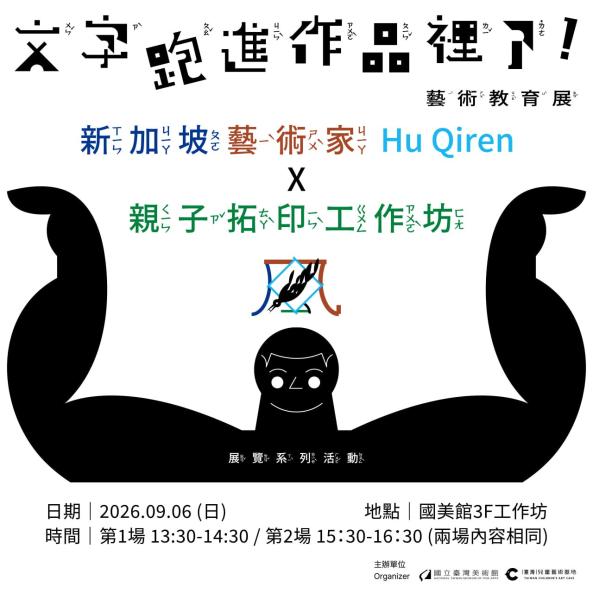
..NTMoFA commission | Hu Qiren(Singapore) "Tracing Memory"..
Did you notice it? In both artworks, words appear together with a “frame”!
In this painting from the NTMoFA’s collection, Shiy De Jinn wrote the black character for “wind” (風), then half-covered it with an orange square. Meanwhile, Singaporean artist Hu Qiren returned to his grandfather’s traditional Chinese medicine shop, taking rubbings of the herb names labeled on cabinet drawers. As it turns out, both artists blend traditional script with modern geometry, transforming words into symbols that hold memory.
While studying abroad, Shiy De Jinn longed to return to Taiwan.
He worried that the island’s beautiful villages, temples, and historic buildings would gradually disappear with time. Hence, he set out to preserve them through his paintings. In this work, the traditional black calligraphic character for wind (風) meets a modern orange square. Partly concealing the character, the square also resembles a window, framing another scene in the painting. Shiy once hoped to bring the beauty of Taiwan to the museum. Now, you are just looking at one of the treasures through which that wish became reality!
Step closer to this “Memory Apothecary,” and it's as if you’re walking right alongside the artist, back into his childhood!
Like Shiy De Jinn, the artist delighted in bringing Eastern and Western ideas together. Returning to his grandfather’s traditional Chinese medicine shop, Hu made rubbings of the characters on cabinet drawers. This work feels like a self-portrait drawn from childhood memories. Look closely at each square and discover how traditional Chinese rubbing techniques and modern Western geometric grids come together, transforming the artwork into a secret place where the artist preserves his memories.

..NTMoFA collection | Lee Jiun Shyan "Rogue Waves"..
X
..NTMoFA commission | Komiya Yukina(Japan)"KAJIKAMI"..
Can you see how both works transform words into powerful lines?
In this work from the NTMoFA’s collection, Lee Jiun Shyan painted the Taiwanese phrase “siáu-káu- íng” on a monumental canvas, turning language into a surging wave of energy. Meanwhile, Japanese artist Komiya Yukina stitches hometown resonance and youth into a giant garment, so that different languages ring out powerful tunes.
A true “master of waves,” Lee Jiun Shyan has depicted more than a dozen different kinds of waves in his practice.
The incorporation of text into painting is also a defining feature of his work. The large composite characters in this piece form the Taiwanese phrase siáu-káu-íng, referring to the rogue waves that are whipped up by strong winds, crashing and spraying wildly in all directions. Here, unruly text and erupting waves seem to shout together, filling each line with a sound. Lee once said that different kinds of waves reflect different weather conditions. Take a close look. Does this formation of “siáu-káu-íng” not resemble a distant fishing vessel navigating through towering waves at sea?
As you approach this “giant garment,” can you hear how the lines of text seem to speak out loud?
The artist transforms Lee Jiun Shyan’s wild, expressive brushwork into a monumental embroidered garment full of “Ūmakū .” On the surrounding walls, she installs fur-like fabric that evokes a surging ocean. As the ceiling breeze passes through the space, the garment and textiles gently sway like waves. Touch the wall lightly, and search for composite characters from different languages stitched across the garment. Notice how language becomes a force that gives the work its power.
Exhibition Info
.png) Words Have Jumped Into Art! - An Art Education Exhibition
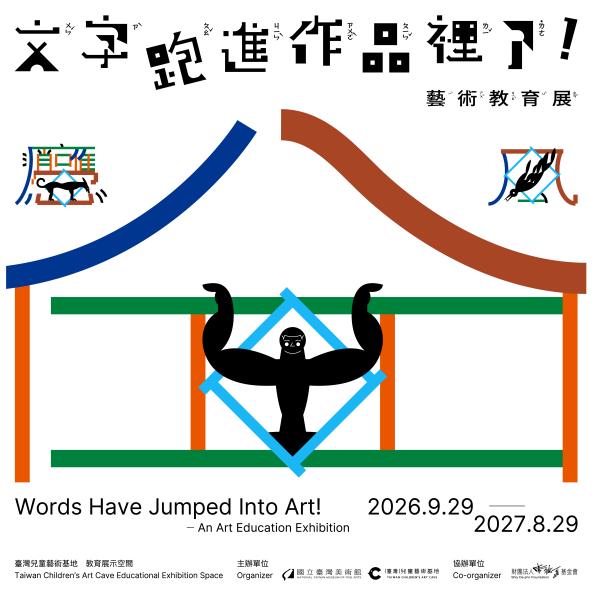
Words Have Jumped Into Art! - An Art Education Exhibition
-8.png) Date:2026.09.29(Tue.)-2027.08.29(Sun.)
Date:2026.09.29(Tue.)-2027.08.29(Sun.)
-8.png) Venue:Taiwan Children’s Art Cave(B1 Educational Exhibition Space)
Venue:Taiwan Children’s Art Cave(B1 Educational Exhibition Space)
(Listed by Chinese surname stroke order)
Participating artists: Song Joo Yean, Komiya Yukina, Hu Qiren
Collection artists: Lyu Fo Ting, Lee Jiun Shyan, Shiy De Jinn
Exhibition curatorial team: Jiang Ming Yang, Huang Li Ting, Liu Hsin Yun
Learning program team: Jiang Ming Yang, Huang Li Ting, Liu Hsin Yun
Exhibition design:Atelier:tt
Graphic design:Teng Yu
Lighting execution:Lai Shin Yu
Exhibition execution:Orogeny Art Space、Crystallize Objects
Translator:Hsu Tien Ying