


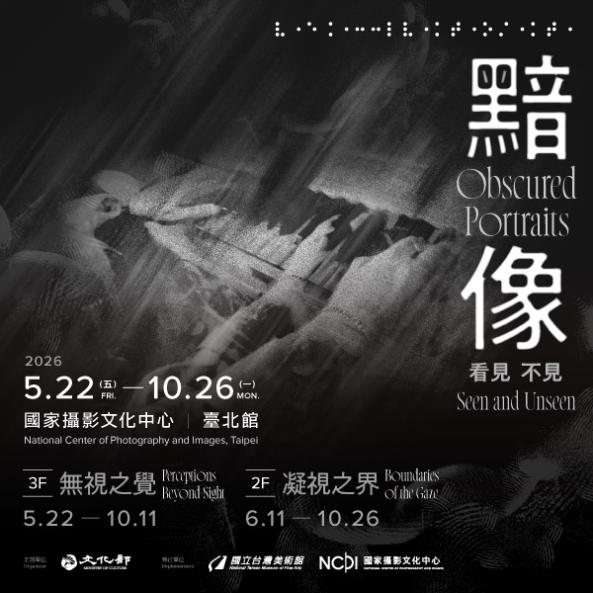
 2026/05/11 10:00
~
2026/10/26 18:00
2026/05/11 10:00
~
2026/10/26 18:00

-
 Organizer
:
Ministry of Culture, National Taiwan Museum of Fine Arts, National Center of Photography and Images
Organizer
:
Ministry of Culture, National Taiwan Museum of Fine Arts, National Center of Photography and Images
-
 Contact Us
:
(02) 8978-7040
Contact Us
:
(02) 8978-7040
-
 Ticket Details
:
free
Ticket Details
:
free
-
 Opening Times
:
10:00 to 18:00 Tuesdays to Sundays
Opening Times
:
10:00 to 18:00 Tuesdays to Sundays
-
 Available Services
:
Audio Guides、Photography Allowed、Information、Wi-Fi
Available Services
:
Audio Guides、Photography Allowed、Information、Wi-Fi
-
 Accessibility Information
:
Visual Impairment
Accessibility Information
:
Visual Impairment
Exhibition Dates:2026.5.22—2026.10.26
( Boundaries of the Gaze:2026.5.22—10.11/Perceptions Beyond Sight:2026.6.11—10.26)
Venue:National Center of Photography and Images, Taipei.
(Boundaries of the Gaze:galleries 301-303,305/Perceptions Beyond Sight:galleries 201-203)
Curator:CHAO Hsin-Yi
Artists:
Evgen BAVČAR, CHANG Chao-Tang, CHANG Chien-Chi,
CHOU Ching-Hui, DENG Nan-Guang, HIROSE Kojiro,
HOU Lulu Shur-Tzy, JIANG Yu-Cheng, JUNG Yeon-Doo,
KO Si-Chi, LIN Bo-Liang, LIU Chen-Hsiang,
Gerardo NIGENDA, NIU Jun-Qiang, TANG Sz-Pan,
WANG Cheng-Hsiang, WANG Yung-An, YU Ru-Ji,
J. Paul Getty Museum's Open Content Program
Universal Design Images:
CHENG Shang-Hsi, HSU Yuan-Fu,
LEE Ming-Tiao, WONG Ting-Hua
Non-visual Creators:
CHANG Yun-Chung, NIEH Li-Hsin, WANG Chin-Shuin,
WU Ching-Ching, ZHU Jun-Yi
Obscured Portraits: Seen and Unseen
Interweaving the visual and non-visual, “Obscured Portraits: Seen and Unseen” addresses essential questions regarding watching versus being watched, and seeing versus not seeing. Using the lens of photography history, it explores how images shape our understanding of existence and non-existence. Navigating distinct perceptual layers and social contexts, the exhibition unfolds across two primary themes: “Boundaries of the Gaze” and “Perceptions Beyond Sight.” Through this framework, it investigates the power dynamics of blind portraiture, the potential of non-visual photography, and cultural representations of disability and class.
“Boundaries of the Gaze” focuses on the blind and how the visually impaired perceive the world through their senses. “Perceptions Beyond Sight,” meanwhile, shifts focus from the blind as subjects of the gaze to overlooked social perceptions. This theme emphasizes commentary and cultural politics inherent in the relationship between disability and class. It features works by sighted photographers and contemporary artists that address themes of blindness, impairment, tactility, and social stratification.
Ultimately, this exhibition explores both aesthetics and photography’s role as a medium for social intervention. As a documentary tool, photography historically shaped the collective image of the disabled, supporting both exclusion and observation. Contemporary photographic practice, however, is self-aware of power dynamics and equality. It seeks to dismantle visual hegemony, respond to the politics of disability, and expand perceptual boundaries.
Boundaries of the Gaze
Under the title “Boundaries of the Gaze,” this floor examines images and voices of the blind and the visually impaired. It traces the tradition of blind portrait photography since the 19th century, investigating how this distinct group has been captured, classified, and represented through the lens of sighted photographers. In the historical archives, the blind and the visually impaired are often relegated to the position of passive objects. They become targets of charity, pity, or medical discipline; their appearances reduced to social metaphors. Besides historical retrospective, this floor also presents inversions of visual power. For example, the “Beyond Vision” section features works by international and local visually impaired photographers. By redefining photography through touch, sound, and mental images, they demonstrate how image capture is not merely an extension of the retina, but rather a multiplicity of perceptual paths. Here, viewing is no longer a unidirectional act, but a dialogue and negotiation across sensory boundaries. Finally, in the pitch-black space of the “Obscura Operation” section, visitors undergo a sensory reset. Through tactile graphs and audio descriptions, they experience a de-visualized, truly inclusive possibility of viewing.
Perceptions Beyond Sight
On this floor the narrative shifts from the historical gaze to somatic perception and a critique of social structures. Centered on the theme “Perceptions Beyond Sight,” the exhibition attempts to unearth the epistemological value of touch, sound, and body memory within our visually dominant culture. Contemporary art installations invite viewers to suspend their reliance on vision, turning instead to the skin, hearing, and smell to read the space and its narratives. The narrative also returns to the social context of Taiwan, exploring how disabilities are not just individual physiological impairments, but also outcomes constructed by social environments and systems. Through the collection of the National Center of Photography and Images, we see how the body of people with visual impairments and blindness is shaped within labor systems, gender norms, and legal restrictions.
Organizer|Ministry of Culture
Implementers|National Taiwan Museum of Fine Arts, National Center of Photography and Images


