



-
 聯絡資訊
:
分機:382
聯絡資訊
:
分機:382
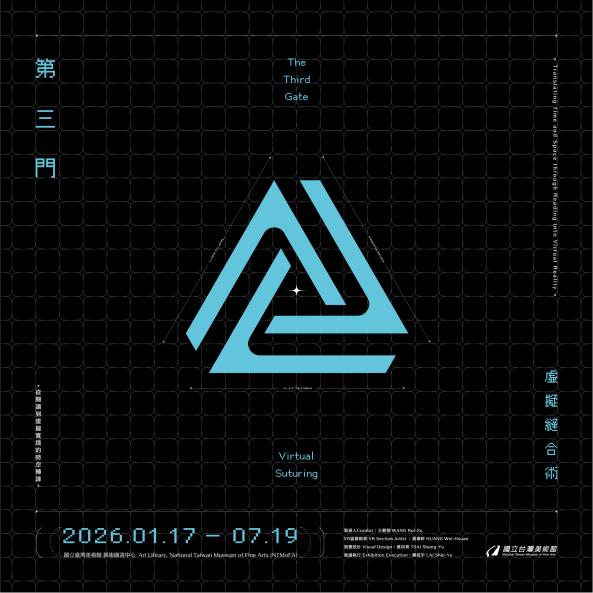
《第三門:虛擬縫合術》
副標:從書寫到虛擬實境的時空轉譯
● 展名:第三門:虛擬縫合術 The Third Gate—Virtual Suturing
● 副標:從書寫到虛擬實境的時空轉譯 Translating Time and Space from Writing to
Virtual Reality
● 展期:2026.01.17-07.19
● 展間 Venue:國立臺灣美術館 藝術圖書中心 Art Library, National Taiwan
Museum of Fine Arts (NTMoFA)
● 策展人Curator:王叡栩 WANG Rui-Xu
● VR 區藝術家 VR Section Artist :黃偉軒 HUANG Wei-Hsuan
● 視覺設計 Visual Design:蔡尚育 TSAI Shang-Yu
● 展場執行Exhibition Execution:賴信宇 LAI Shin-Yu
● 展覽論述:
在這場書展中,「門」被視為一種隱喻。它不僅是一個物理性的界面,更是一種轉換
的符號,指向人類如何跨越不同的存在層次。現實與虛擬構成了兩個並行卻交織的世
界:一方是身體與日常所在的現實空間,另一方則透過虛擬實境技術生成,以沉浸的
方式在感官與想像中展開。當「閱讀」被重新放入這樣的結構中,它所開啟的,不再
只是知識的傳遞,而是一種跨越感知、技術與想像的行動——一扇通往「第三個門」
的入口。
閱讀在此被視為方法,也是一種體驗技術。它使時間得以展開,也讓空間得以折疊:
從書頁上的文字,展延虛實的皺褶與想像的邊界;從心智圖的網絡,觸及知識的生成
與流動。當書本與虛擬實境並置,閱讀的身體也被重新定義——閱讀既非純然的線性
延續,也不是靜止的知識再現,而是一種轉譯的實踐:在其中,時間化為可居的空
間,記憶生成可感的場域。
「第三個門」象徵這種跨越。第一道門屬於現實,第二道門屬於虛擬實境,而第三道
門則源於閱讀的介入——它將書寫、閱讀、技術與感知縫合在一起,構成一種能夠流
動、生成與差異化的感知空間。在此,閱讀不再只是理解,而是一種開啟維度的方
法,使人得以在現實與虛擬實境之間,生成新的觀看與思考的方式。
因此,本展不僅是書籍的集合或展示,而是一場思維與感官的實驗。觀眾將從心智圖
與文本的閱讀出發,進而前往VR 藝廊中體驗作品,進入一個多層次的轉譯過程。書寫
與閱讀在此既是入口,也是生成的技術;它們讓人得以穿越「第三門」,在現實與虛
擬實境之間,拓墣出屬於自身的思考縫隙。
The Third Gate—Virtual Suturing
Subtitle: Translating Time and Space from Writing to Virtual Reality
In this book exhibition, the “gate” is conceived as a metaphor—not merely a physical interface,
but a symbol of transition that points to how human beings cross between different layers of
existence. Reality and the virtual constitute two parallel yet intertwined worlds: one grounded
in the real space of the body and everyday life, and the other generated through virtual reality
technologies, unfolding immersively across the senses and imagination. When reading is
repositioned within this structure, it no longer serves as a conduit of knowledge alone, but
becomes an act that traverses perception, technology, and imagination—an entrance leading
toward the third gate.
Reading here is regarded as a method and also as a technology of experience. It allows time
to unfold and space to fold upon itself: from the written page, it extends the creases between
the real and the virtual, tracing the edges of imagination; from the networks of the mind map,
it touches upon the becoming and circulation of knowledge. When books are placed alongside
virtual reality, the act of reading itself is redefined—the body of reading becomes part of the
immersive system. Reading is neither purely linear nor a static reproduction of knowledge,
but a practice of translation: within it, time transforms into inhabitable space, and memory
generates perceptible fields.
The third gate symbolizes this crossing. The first gate belongs to reality, the second to virtual
reality, and the third arises through the mediation of reading—it weaves together writing,
reading, technology, and perception into a space that flows, generates, and differentiates.
Here, reading is no longer an act of comprehension, but a method of opening dimensions,
enabling one to form new ways of seeing and thinking between reality and virtual reality.
Thus, this exhibition is not merely a collection or display of books, but an experiment in
thought and perception. Visitors begin with the reading of mind maps and texts, then move
into the VR gallery to experience the works, entering a multilayered process of translation.
Writing and reading here serve both as thresholds and as generative techniques; through
them, one may pass through The Third Gate and suture a personal fissure of thought between
reality and virtual reality.


