


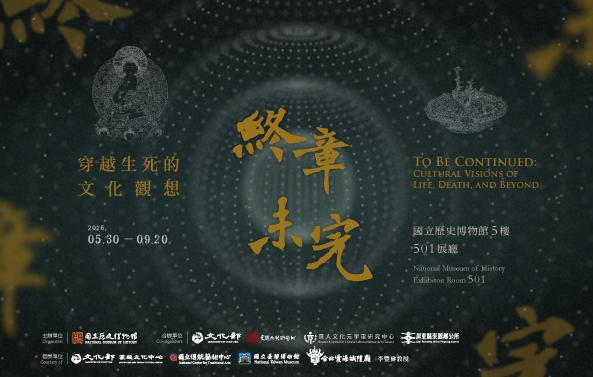
This exhibition centers on traditional Han Chinese and Taiwanese Indigenous perspectives on life and death, exploring how different cultural traditions—including Buddhism, Taoism, Confucianism, and ancestral spirit beliefs—have understood death, memory, and the continuation of life. Through religious artifacts, artworks, historical imagery, and digital interactive installations, the exhibition invites visitors to reconsider a timeless and universal question: Is death truly the end?
Across human civilizations, death has never been viewed merely as the conclusion of life, but rather as a form of transformation and continuation. Buddhism interprets life and death through reincarnation and liberation; Taoism emphasizes the balance of yin and yang and the order of the spiritual realm; Confucianism values ancestral remembrance and ethical continuity; while Taiwanese Indigenous cultures sustain connections with ancestors through spiritual traditions in which the departed continue to protect their families and communities. Through these diverse cultural perspectives, the exhibition reveals how different societies have responded to the mysteries of mortality through ritual, belief, and collective memory.
The exhibition also enters into a cross-cultural dialogue with the museum’s concurrent special exhibition, Egyptian Mummies: Journey into Immortality, presenting contrasting Eastern and Western interpretations of the afterlife. From the Ten Kings of Hell and reincarnation to ancient Egyptian mummies and the judgment of eternal life, visitors journey through multiple cosmologies, encountering humanity’s shared anxieties, beliefs, and hopes surrounding death and the world beyond.
In addition, the exhibition incorporates AI-generated imagery, interactive games, and digital curatorial practices to create immersive experiences such as the Digital Ten Kings Scroll Experience, an AI Interactive Storybook, and a participatory Wall of Memories. Through technological media, audiences are encouraged to reflect on the relationships between death, memory, and emotion, while opening new conversations about the meaning of life and human existence in contemporary society.
The exhibition is also developed in connection with the National Museum of History’s sustainability initiative, Low-Carbon Exhibitions: Advancing Sustainable Curatorial Practices. Low-carbon concepts were integrated into the exhibition design through the use of modular display systems, reusable exhibition structures, environmentally friendly materials, and energy-efficient LED lighting. QR codes and digital interactive devices replace portions of printed materials and physical outputs, demonstrating a curatorial approach that integrates cultural presentation with environmental sustainability.
When we gaze upon death, we are also reconsidering life itself. To Be Continued is not only an exhibition about death, but also an ongoing dialogue about memory, culture, sustainability, and the continuation of life.
| Venue. |
 國立歷史博物館5樓
|
| Date. | 2026/05/30 ~ 2026/09/20 |


