


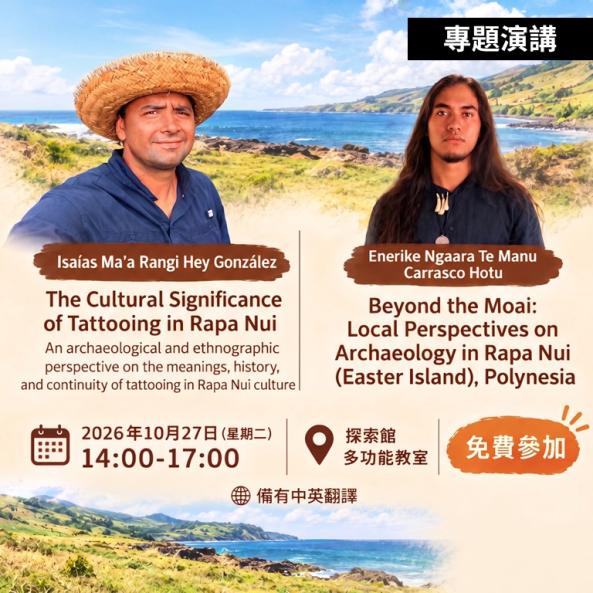
本次專題演講特別邀請2位拉帕努伊島考古學及文化工作者,以在地視角分享考古學與社群參與,並結合考古學及民族誌解讀,探討紋身的文化意義、歷史及延續性。
 2026/10/27 14:00
~
2026/10/27 17:00
2026/10/27 14:00
~
2026/10/27 17:00
 場次介紹
場次介紹
 報 名 期 間
 名 額
名 額
 講 師
講 師

-
 主辦單位
:
國立臺灣史前文化博物館
主辦單位
:
國立臺灣史前文化博物館
-
 聯絡資訊
:
王先生 089-381166分機335;ccwang@nmp.gov.tw / 吳小姐 089-381166分機336;wush117@nmp.gov.tw
聯絡資訊
:
王先生 089-381166分機335;ccwang@nmp.gov.tw / 吳小姐 089-381166分機336;wush117@nmp.gov.tw
講題1/Title 1
The Cultural Significance of Tattooing in Rapa Nui: An archaeological and ethnographic perspective on the meanings, history, and continuity of tattooing in Rapa Nui culture(拉帕努伊島紋身的文化意義:從考古學和民族誌的角度探討拉帕努伊文化中的紋身意義、歷史和延續性)
講者1/Speaker 1
Isaías Ma’a Rangi Hey González(考古學者、文化資產保存工作者)
I am a 33-year-old archaeologist with a Rapanui father and a Chilean mother. I grew up on Rapa Nui, learning traditional farming, fishing, and respect for the island’s natural resources. I have worked with national and international research teams, and today I live on Rapa Nui with my partner and our three-year-old daughter, Anani.
我是一名33歲的考古學者,父親是拉帕努伊人,母親是智利人。我在拉帕努伊島長大,學習傳統的耕作、捕魚方式,並且懂得尊重島上的天然資源。我曾與國內外的研究團隊合作,如今我和伴侶以及我們3歲的女兒阿納尼一起住在拉帕努伊島。
演講摘要1 /Abstract 1
Tattooing, tātū, holds a significant place in Rapa Nui cultural history, where the human body became a space for expressing identity, status, memory, and social relationships. This presentation explores the meanings and historical development of Rapa Nui tattooing through an archaeological and ethnographic perspective, bringing together early historical accounts, visual records, material culture, oral traditions, and comparative evidence from Polynesia. Rather than approaching tattooing primarily as body decoration, the presentation considers it as a cultural practice embedded within the social and symbolic world of Rapa Nui. Particular attention is given to documented motifs, their placement on the body, possible associations with gender, status, genealogy, spirituality, and social identity, and the challenges involved in interpreting fragmentary historical sources. Archaeological and museum collections are also considered as sources for understanding representations of the tattooed body. Finally, the presentation addresses the continuity and contemporary revitalization of Rapa Nui tattooing, examining how ancestral knowledge is interpreted, transmitted, and transformed today. Tattooing thus provides a powerful lens through which to explore cultural memory, identity, and resilience in Rapa Nui.
紋身(tātū)在拉帕努伊的文化歷史中具有舉足輕重的地位,人體在此成為展現身分認同、階級地位、群體記憶與社會關係的載體。本演講將從考古學與民族誌視角,梳理拉帕努伊紋身的象徵意涵與歷史演變,並匯整早期歷史文獻、圖像紀錄、物質文化、口述傳統及玻里尼西亞的跨區域比較材料。
相較於將紋身單純視為身體裝飾,本演講更將其視為深植於拉帕努伊社會結構與符號世界中的文化實踐。內容將特別聚焦於現存文獻所記載的紋樣圖案、刺染部位,以及其與性別、階級、譜系、精神信仰及社會認同之間的潛在關聯;同時亦將探討在解讀殘碎史料時所面臨的研究挑戰。此外,考古出土遺物與博物館藏品亦將作為理解受紋身軀表現形式的重要依據。
最後,演講將聚焦拉帕努伊紋身文化的延續與當代復振,剖析祖先智慧在當代社會如何被重新詮釋、傳承與轉化。紋身不僅是一門古老技藝,更成為探究拉帕努伊文化記憶、族群認同與文化韌性的關鍵視角。
講題2/Title 2
Beyond the Moai: Local Perspectives on Archaeology in Rapa Nui (Easter Island), Polynesia(超越摩艾:玻里尼西亞拉帕努伊(復活節島)考古學的在地視角)
講者2/Speaker 2
Enerike Ngaara Te Manu Carrasco Hotu(考古學者、文化資產保存工作者)
My work focuses on cultural revitalization and the study of the tangible and intangible heritage of Rapa Nui, integrating archaeological research with oral tradition, the Rapanui language, and community work. I have participated in projects to document museum collections, compile ancestral knowledge, and promote training for young people on the island.
我的工作聚焦於文化復振,以及拉帕努伊有形與無形文化資產的研究,致力結合考古學研究與口述傳統、拉帕努伊語及在地社群工作。我曾參與多項博物館藏品著述、祖先傳統知識彙編,以及推動島上青年培力的相關計畫。
演講摘要2 /Abstract 2
Few places in the world have been as influenced by archaeology as Rapa Nui, Polynesia. So much so that, just as the tree keeps us from seeing the forest, the moai keeps us from seeing the people. The constant focus on “mysteries” such as the Rongorongo script or megalithic monuments has prevented deeper engagement with everyday aspects of ancient Rapanui life, while historically rendering present-day local agency invisible. This paper addresses the relevance of an Indigenous approach to archaeological research in Rapa Nui, understanding that archaeological knowledge is produced not solely within the discipline but through interaction with local communities. Drawing on my experience in museum work, community collaboration, cultural initiatives, and repatriation, I analyze how two knowledge frameworks are articulated and placed in tension: archaeology as scientific practice and traditional Rapanui knowledge. The paper draws on three key experiences: my undergraduate thesis on integrating archaeological and Rapanui knowledge for the study of matā (stemmed obsidian artifacts); the Archivo Razonado Project (MChAP), which resignifies Indigenous collections through local perspectives; and the Haka Ma’a Kainga summer school. I argue that active community participation throughout the archaeological process is both an ethical dimension and a necessary condition for broadening understandings of the past.
世界上鮮少有地方像玻里尼西亞的拉帕努伊一樣,深受考古學的深遠影響;甚至到了「見樹不見林,見摩艾而不見人」的程度。外界對朗格朗格(Rongorongo)木板文字或巨石雕像等「未解之謎」的持續關注,往往阻礙了人們進一步探究古代拉帕努伊人的日常生活樣貌,更在歷史脈絡中掩蓋了當代在地族人的主體能動性。
本演講探討以原住民族視角開展拉帕努伊考古研究的重要意涵,並指出考古學知識絕非僅在學科體系內部生成,更需藉由與在地社群的互動共同建構。結合我在博物館實務、社群協作、文化行動及文物返還工作中的經驗,演講將剖析「作為科學實踐的考古學」與「傳統拉帕努伊知識」這兩套知識體系如何相互銜接並形成張力。
本篇論述奠基於三大核心實踐經驗:將考古學與拉帕努伊在地知識結合、用以研究帶柄黑曜石石器(matā)的學士學位論文;透過在地視角重新賦予原住民館藏文化意涵的「理性檔案計畫」(Archivo Razonado Project, MChAP);「Haka Ma’a Kainga」夏令營。
我認為,社群在整個考古研究過程中的主動參與,不僅是涉及倫理面向,更是拓展我們對過去深層理解不可或缺的必要條件。
本次演講備有中英翻譯
個人資料提供告知事項暨同意書
國立臺灣史前文化博物館(以下簡稱本館)重視並保護您的個人資料。當您在為線上申辦系統使用時,系統會需要向您蒐集必要的個人識別資料,包括:姓名、電子郵件信箱、聯絡地址、聯絡電話、身分證字號等資料,以便為您提供預約導覽、場地租借等服務。在您提供個人資料之前,請詳閱下列告知事項,以維護您的權益。
- 本館線上申辦系統依個人資料保護法等相關法令規定,在主管機關所核准之特定目的範圍內蒐集您的個人資料。
- 個資之類別:
● C001識別個人者:姓名、電子郵件信箱、聯絡地址、聯絡電話等資料。
● C003政府資料中之辨識者:身分證字號或護照號碼(外國人)。 - 個人資料利用之期間、地區:本館申請之網頁。
- 個人資料利用之對象、方式:本館基於服務之特定目的內,將申請相關資料將留存於相關組室,供服務目的內處理利用。
- 相關資訊:申請人就查詢有關之資訊,除可至本館官網查詢外,亦可來電服務專線:
康樂本館 (089)381166轉777
卑南遺址公園 (089)233466轉219
南科考古館 (06)5050905轉8101 - 本館線上申辦系統基於上述原因而需蒐集、處理或利用您的個人資料時,您可以自由選擇是否提供您的個人資料。若您選擇不提供個人資料或提供不完全時,您將無法進行線上申辦及上述各項相關權益。
- 您瞭解此一同意書符合個人資料保護法及相關法規之要求,具有書面同意本館蒐集、處理及利用您的個人資料之效果。


